
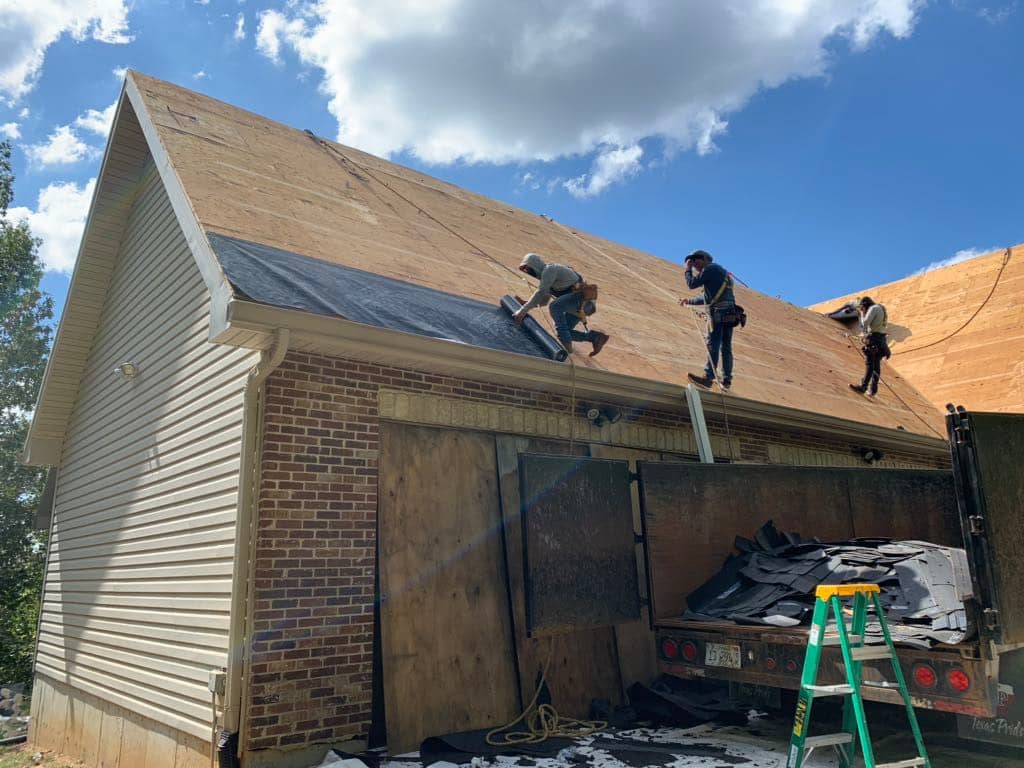
Of all the components in a residential roofing system, the ice and water shield is the one most Ottawa homeowners have never heard of, cannot see once the roof is complete, and are least likely to ask about when getting a quote for a roof replacement.
It is also, in Ottawa’s climate, the single most consequential layer between the shingles and the roof deck. When ice dams form along the eaves in winter and force meltwater back under the shingles, the ice and water shield is what stops that water from entering the structure. When it is installed correctly with adequate coverage, it works. When it is installed at the bare minimum or skipped entirely, homeowners end up with stained ceilings, wet insulation, and rotting decking that could have been prevented.
This guide explains what ice and water shield is, how it works, why Ottawa’s climate makes it more important than in most places, what the Ontario Building Code requires versus what actually protects your home, and what to ask your contractor.
Key Takeaways
- Ice and water shield is a self-adhering waterproof membrane applied directly to the roof deck beneath the shingles. It is the last line of defense when water is forced under the shingles by ice dams or wind-driven rain.
- Ontario Building Code requires ice and water shield to extend a minimum of 24 inches (roughly two feet) past the inside face of the exterior wall at the eaves. In Ottawa’s climate, this minimum leaves significant portions of the eave and valley area unprotected.
- Tailored Home Improvements installs six feet of Resisto ice and water shield at all edges and valleys as standard practice, which is three times the code minimum.
- The membrane is completely invisible once the roof is installed. Homeowners have no way to verify the coverage after the fact, which makes asking about it before the work begins essential.
- Ice and water shield is not the same as standard underlayment. Traditional felt or synthetic underlayment sheds water that lands on it, but it does not seal around nail penetrations or create a fully waterproof barrier the way ice and water shield does.
What Ice and Water Shield Actually Is
Ice and water shield is a self-adhering membrane made of rubberized, polymer-modified asphalt backed by a slip-resistant polyethylene film. When pressed onto the roof deck, it forms a continuous, fully adhered waterproof layer.
What makes it different from standard roofing underlayment (felt paper or synthetic underlayment) is two things. First, it is fully waterproof, not just water-resistant. Standard underlayment sheds water that lands on it from above, which is adequate under normal conditions where water flows down the roof surface and off the edge. But when water is being pushed back up under the shingles by an ice dam, standard underlayment is not designed to stop it. Ice and water shield is.
Second, and critically, ice and water shield self-seals around nail penetrations. Every roofing nail driven through the roof deck creates a potential path for water. Standard underlayment does nothing to seal those holes. When water reaches them, it follows the nail through the deck and into the attic. Ice and water shield’s rubberized composition compresses around the nail shaft and seals the puncture, closing off that pathway.
These two properties, complete waterproofing and nail-penetration sealing, are what make ice and water shield the last line of defense in a roofing system. The shingles are the primary water-shedding layer. The ice and water shield is what protects the structure when the shingles alone are not enough.
Why It Matters More in Ottawa Than Most Places
Ottawa experiences over 50 freeze-thaw cycles per year. That number is not a rough estimate. It reflects the region’s well-documented pattern of temperatures swinging above and below zero throughout the winter and shoulder seasons, sometimes multiple times in a single week.
Each freeze-thaw cycle creates the conditions for ice dam formation. Heat escaping from the living space into the attic warms the roof deck. Snow on the roof surface melts. The meltwater runs down toward the eaves, which are colder because they extend beyond the heated wall line, and refreezes. Over multiple cycles, a ridge of ice builds up at the eave. That ridge traps meltwater behind it, and the trapped water is forced back up under the shingles.
This is the moment when the ice and water shield matters. If the membrane extends far enough up the roof from the eave, the water hits a sealed, waterproof surface and cannot penetrate. If the membrane stops too early, the water flows past it and reaches the unprotected roof deck, where it follows nail holes and gaps into the attic.
Ottawa also receives heavy snowfall, sustained wind events that drive rain horizontally under shingle edges, and intense spring melt that concentrates large volumes of water at the eaves and in the valleys. All of these conditions test the limits of a roofing system’s waterproofing, and all of them are conditions the ice and water shield is specifically designed to handle.
A roof in a milder climate can get away with minimal ice and water shield coverage because the conditions that test it occur less frequently and less severely. In Ottawa, those conditions are routine.
What the Ontario Building Code Requires vs. What Actually Protects Your Home
Ontario Building Code requires ice and water shield to extend from the edge of the roof to at least 24 inches (two feet) past the inside face of the exterior wall at the eaves. This is the minimum. It applies to the eaves only, where ice dams are most likely to form.
In practice, this minimum coverage provides protection for a narrow strip along the very edge of the roof. On many Ottawa homes, where eave overhangs are 12 to 18 inches deep, two feet of coverage past the interior wall line means the ice and water shield extends only a short distance up the roof deck from the edge.
The problem with this minimum is that it assumes ice dams are small and meltwater does not travel far back under the shingles. In Ottawa, that assumption is often wrong. A significant ice dam can force water several feet up the roof slope before it finds a gap and enters the structure. When the ice and water shield stops at two feet, the water simply travels past it.
This is why many experienced Ottawa roofers install more coverage than code requires. The gap between the code minimum and what actually provides adequate protection in this climate is real and measurable.
At Tailored Home Improvements, we install six feet of Resisto ice and water shield at all eaves and valleys as standard practice. That is three times the code minimum, and it is not offered as an upgrade or an add-on. It is part of every roof we install because Ottawa’s climate demands it.
Six feet of coverage means the ice and water shield extends well past the point where meltwater from a typical Ottawa ice dam is likely to travel. It provides meaningful protection not just at the eave edge but across the transition zone where the heated living space meets the unheated soffit area, which is exactly where water infiltration most commonly occurs.
Where Ice and Water Shield Should Be Installed
Eaves are the primary location, but they are not the only area that needs protection.
Roof valleys are the angled channels where two roof planes meet. Water from both slopes converges in the valley and flows toward the eave at concentrated volume. Valleys see more water per linear foot than any other part of the roof, and they are a common failure point if the ice and water shield does not extend far enough up each slope from the valley centre.
Around roof penetrations including chimneys, skylights, plumbing vents, and exhaust vents. Every penetration is a break in the roof surface and a potential entry point for water. Ice and water shield installed beneath the flashing at these locations provides a secondary waterproof layer if the flashing seal fails, which in Ottawa’s freeze-thaw climate it eventually will.
Low-slope areas where the roof pitch is shallow. Water moves more slowly on a low-slope section and has more time to find gaps. Ice and water shield coverage on low-slope areas compensates for the reduced natural drainage.
Why You Cannot Verify It After the Roof Is Installed
This is the most important practical point in this entire guide.
Once the shingles are installed, the ice and water shield is completely invisible. There is no way for a homeowner to look at a finished roof and determine how much ice and water shield was applied beneath the shingles, or whether it was applied at all.
This means that the only time you can influence the quality of this critical layer is before the work begins. Specifically, that means asking your contractor three questions.
What brand and type of ice and water shield do you use? This tells you whether they are using a quality product or a generic alternative.
How many feet of coverage do you install at the eaves and valleys? This tells you whether they are installing the bare code minimum or providing coverage that actually matches Ottawa’s demands.
Is ice and water shield included in your standard scope of work, or is it priced as an upgrade? A contractor who treats adequate ice and water shield coverage as standard practice rather than an upcharge is telling you something about their overall approach to quality.
If a contractor cannot answer these questions specifically, or if the answers are vague, that is worth noting before you sign.
How Tailored Home Improvements Approaches Ice and Water Shield
We use Resisto ice and water shield on every roof we install. Resisto is a Canadian-manufactured membrane with a strong track record in Ottawa’s climate conditions.
We install six feet of coverage at all eaves and valleys as standard practice, not as an upgrade. This is three times the Ontario Building Code minimum and reflects our assessment of what Ottawa’s freeze-thaw climate actually requires.
We also install ice and water shield around every roof penetration: chimneys, skylights, plumbing vents, and exhaust vents. These areas are secondary failure points that many contractors under-protect.
Combined with our six to eight nail per shingle installation standard and our commitment to proper attic ventilation assessment on every project, the ice and water shield coverage is part of a system-level approach to making sure a roof performs for its full rated lifespan in this climate. No single component does the job alone. The shingles, the membrane, the ventilation, and the installation practices all have to work together.
If you are getting quotes for a roof replacement in Stittsville, Kanata, Barrhaven, Nepean, or surrounding Ottawa communities, ask every contractor you speak with how much ice and water shield they install. Compare the answers. The differences will tell you a lot about the quality of the roof you are going to get.
Request a free quote →
Frequently Asked Questions
What is ice and water shield on a roof?
Ice and water shield is a self-adhering waterproof membrane applied directly to the roof deck beneath the shingles. It is made of rubberized, polymer-modified asphalt that creates a fully waterproof barrier and self-seals around nail penetrations. Its primary function is to prevent water infiltration when ice dams or wind-driven rain force water under the shingles, which standard underlayment is not designed to stop.
How much ice and water shield does Ontario Building Code require?
Ontario Building Code requires ice and water shield to extend from the edge of the roof to at least 24 inches (two feet) past the inside face of the exterior wall at the eaves. This is the minimum requirement. In Ottawa’s climate, where ice dams routinely force meltwater several feet back under the shingles, many experienced contractors install significantly more than the minimum. Tailored Home Improvements installs six feet of coverage at all eaves and valleys as standard practice.
Is ice and water shield the same as roof underlayment?
No. Standard underlayment (felt paper or synthetic underlayment) is water-resistant and sheds water that lands on it from above. Ice and water shield is fully waterproof and self-seals around nail penetrations, providing a complete barrier against water that is forced under the shingles from below by ice dams or wind. The two products serve different functions and ice and water shield is not a substitute for standard underlayment across the full roof deck; it is installed in addition to underlayment at the most vulnerable locations.
Can I check how much ice and water shield is on my existing roof?
Not without removing the shingles. The ice and water shield is completely hidden once the roof is installed. There is no visible exterior indicator of how much coverage was applied or whether it was applied at all. This is why asking your contractor about ice and water shield coverage before the work begins, and verifying that it is included in the written scope of work, is essential.
What is Resisto ice and water shield?
Resisto is a Canadian-manufactured self-adhering roofing membrane made by Soprema. It is widely used across Canada for ice and water protection on residential roofs. Resisto membranes are engineered for the freeze-thaw conditions common in Canadian climates and are the product Tailored Home Improvements uses on every roof installation.