

How to Choose a Roofing Contractor in Ottawa

Tailored Home Improvements inspecting a roof for quotation

Replacing your roof is one of the larger home investments you will make. In Ottawa, where a properly installed roof needs to hold up against heavy snow loads, ice dams, sustained freezing temperatures, and strong winds, the contractor you hire matters as much as the materials they use.

The Ottawa roofing market includes a mix of established local companies and transient operators who work out of a truck, underbid established businesses significantly, and disappear when problems arise. Knowing how to tell the difference before you sign anything can save you from a costly and stressful situation.

This guide covers what to verify, what to ask, what good answers look like, and what should send you elsewhere.

Start With Insurance — Before Anything Else

The first thing to confirm with any roofing contractor in Ottawa is their insurance coverage. This is not a formality. A contractor without proper insurance can expose you as the homeowner to significant liability if a worker is injured on your property.
There are two distinct types of coverage to ask for.
 
WSIB (Workplace Safety and Insurance Board) coverage is the Ontario workplace insurance system. Any roofing contractor operating in Ontario should be registered with WSIB and able to provide a clearance certificate. You can verify a contractor’s WSIB status independently at wsib.ca by entering their clearance number. If a contractor cannot provide this, or becomes evasive when you ask, stop there.
 
Liability insurance covers damage to your property during the project. Ask for a copy of the contractor’s certificate of liability insurance and confirm the policy is current. A minimum of $2 million in coverage is a reasonable standard for a residential roofing project in Ottawa.
 
Both documents should be provided without hesitation by any contractor who runs a legitimate operation. Asking for them is standard and expected.
 

Verify They Are a Local, Established Business

Roofing is a trade that attracts transient operators, particularly in spring when demand spikes after a hard winter. Some of these operators underbid local companies meaningfully, do substandard work, and either close or rebrand before warranty issues surface.
 
A few straightforward ways to verify you are dealing with an established local business:
A physical address is a starting point. A contractor operating out of a truck or a P.O. box with no fixed location carries more risk than one with a verifiable local address. Search the business name and address to confirm it exists.
 
Check the BBB. The Better Business Bureau maintains accreditation records and complaint histories. A BBB-accredited contractor has agreed to abide by standards of honest advertising and dispute resolution. An unresolved complaint history or a lack of any online presence at all are both worth noting.
 
Google reviews give you a sense of how a company has actually performed for Ottawa homeowners. Look at the substance of the reviews, specific project details, how the company handled problems rather than just the star count.
Understand Who Is Actually Doing the Work
 
One of the most important questions you can ask a roofing contractor in Ottawa is straightforward: will your own employees be doing the work, or will you be using subcontractors?
 
This question matters because many roofing companies operate as a sales and coordination layer. They acquire the job, then subcontract the actual installation to crews they may not directly employ or supervise. Those crews are typically paid per roof completed, which creates an incentive to move quickly rather than carefully.
 
A contractor who employs their own full-time, hourly-paid crew has a different dynamic. The crew’s livelihood does not depend on how fast they complete each job. Quality control rests with the company rather than with a rotating group of subcontractors. And warranty obligations are easier to honour when the people who installed the roof still work for the company.
 
Ask the question plainly and listen carefully to the answer. “We use trusted subcontractors” is a different answer from “Our crew are all our own full-time employees.”
 

Ask About Their Installation Standards

Beyond who does the work, ask about how they do it. The specific installation practices a contractor follows have a direct impact on how long your roof performs in Ottawa’s climate.
 
Two questions worth asking directly:
 
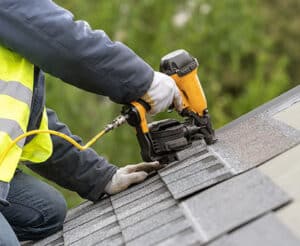
How many nails per shingle do you use? The Ontario Building Code requires a minimum of four nails per shingle. Four nails is the floor, not a benchmark. A contractor who installs with six to eight nails per shingle is building significantly more wind resistance into every shingle on your roof. In a region where windstorms are common year-round, this is a meaningful difference.
 
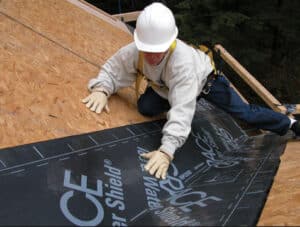
How much ice and water shield do you install? Ice and water shield is the self-adhesive waterproof membrane applied under the shingles at the eaves and valleys — the areas most vulnerable to ice dam infiltration during Ottawa winters. The code minimum requires two feet of coverage at the eaves. A contractor installing six feet along all edges and valleys is providing substantially more protection against the ice dam damage that Ottawa winters reliably produce. Ask specifically how much they apply as a standard practice, not as an optional upgrade.
 

A contractor who knows their trade will answer these questions confidently and specifically. Vague answers or deflection are worth noting.
Roof Repair

Get a Written Quote With Full Detail

A proper quote should specify the materials being used, including the shingle manufacturer and product line. It should describe the scope of work — tear-off of existing material, disposal, underlayment, ice and water shield coverage, starter strips, ridge cap — so that you can compare quotes from different contractors on equal terms. It should include the workmanship warranty offered in addition to the manufacturer’s material warranty.
 
Pay attention to what is not in the quote as much as what is. A quote that does not specify materials leaves room to substitute inferior products. A quote that does not specify disposal of old materials may result in a surprise charge or debris left on your property.
 

Get at least three written quotes before making a decision. You are not looking for the cheapest option — you are looking for the most complete and transparent one at a fair price.

Understand the Warranty

Roofing warranties have two distinct components that are often misunderstood.
The manufacturer’s material warranty covers defects in the shingles themselves. These warranties are typically 25 to 50 years for architectural shingles, but they come with conditions. Most require professional installation, and some require the contractor to be a certified installer for that manufacturer. A warranty that sounds impressive may offer less coverage than it appears to if the installation conditions were not met.
 
The workmanship warranty is the contractor’s own guarantee on the quality of their installation. This warranty is separate from the manufacturer’s and covers issues that arise from how the roof was installed — flashing failures, improper sealing, inadequate nailing. Workmanship warranties vary widely: some contractors offer two years, others offer ten or twenty. Ask specifically what the workmanship warranty covers, how long it runs, and what the process is if a problem arises.
 
Both warranties should be provided in writing before work begins. A contractor who is reluctant to commit their warranty terms in writing is telling you something important.
 

Red Flags to Watch For

Some warning signs are worth knowing before you start collecting quotes.
 
Pressure to decide immediately. A legitimate contractor will give you time to review your quote and make an informed decision. High-pressure tactics — a price that “expires today,” or urgency around a limited crew availability — are sales techniques, not service.
 
No written contract. A handshake deal or a verbal agreement has no enforceability. If a contractor resists putting the scope, materials, price, timeline, and warranty in writing, do not proceed.
 

A quote significantly below all others. A quote that is 30 to 40 percent below the others you have received warrants scrutiny, not celebration. The most common reasons for an unusually low quote are: inferior materials, no WSIB or liability coverage, use of uninsured subcontractors, or a scope that omits work others have included. Find out why before assuming you found a better deal.

How Tailored Home Improvements Approaches This
At Tailored Home Improvements, we are a Stittsville-based roofing company serving Ottawa’s west end. Every member of our installation crew is a full-time employee paid by the hour, not per roof. We do not use subcontractors.
 
We carry WSIB coverage and liability insurance and will provide documentation for both. We install every roof with six to eight nails per shingle and ice and water shield at all edges and valleys as standard practice. We offer a 50-year manufacturer warranty on materials and a 20-year workmanship guarantee. We are BBB Accredited and have been serving Ottawa-area homeowners with 16+ years of experience.
 
If you are getting quotes for a roof replacement or repair in Stittsville, Kanata, Barrhaven, Nepean, or surrounding Ottawa west communities, we are happy to be one of them.

Ice and Water Shield for Valleys

Frequently Asked Questions

How do I verify a roofing contractor’s WSIB coverage in Ontario?
Ask the contractor for their WSIB clearance certificate and verify the clearance number at wsib.ca. The WSIB online tool confirms whether a contractor’s account is in good standing. This takes less than a minute and is worth doing before any work begins.
 
Does Ontario require roofing contractors to be licensed?
Roofing is not a compulsory trade in Ontario, meaning there is no mandatory provincial licence required to call yourself a roofing contractor. This makes independent verification of WSIB coverage, liability insurance, BBB accreditation, references, and time in business more important, not less. The absence of a licensing requirement means the onus is on the homeowner to vet contractors carefully.
 
What should a roofing contract include in Ontario?
A complete roofing contract should specify: the contractor’s name, address, and insurance information; a full description of the work including; removal and disposal of existing materials; ice and water shield and underlayment specifications; projected start and completion dates; total price and payment schedule; and the workmanship warranty in full. Do not sign a contract that is missing any of these elements.
 
What is the difference between a manufacturer warranty and a workmanship warranty on a roof?
The manufacturer warranty covers defects in the roofing materials themselves — shingles, underlayment — and is provided by the shingle manufacturer. It typically runs 25 to 50 years but has conditions around installation. The workmanship warranty is the contractor’s own guarantee on the quality of their installation work and covers issues like improper flashing or fastening. These are two separate warranties, and both should be provided in writing.


Table of Contents

Our Social Media Accounts

Click on the icon below to check out our social media accounts!

Ottawa's Trusted Home Improvement Contractor

Are you in need of home improvements? Tailored Home Improvements is here to assist you! Contact us today for more information about our services or to request a free quote. We are dedicated to enhancing your home’s energy efficiency, comfort, and overall appeal.